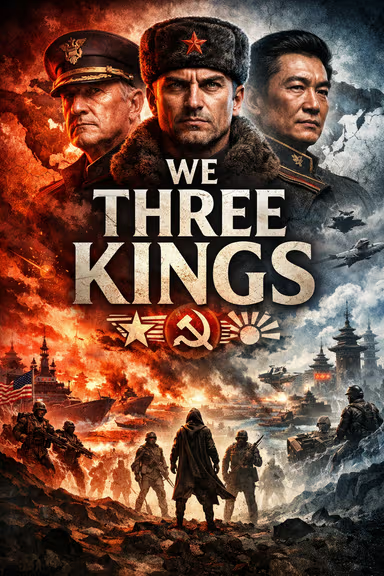
The Arctic Flashpoint
The Drone Incident
The biting wind swept mercilessly across the barren Arctic expanse, the horizon fragmented into jagged shards of ice and the cold mist of wavering sea spray. High above, a sleek unmanned aerial vehicle—an advanced multirole drone designated VX-101—glided silently through the swirling gray clouds, its composite frame barely visible against the overcast canvas. With a wingspan built for endurance and agility, it surveyed a contested stretch of the polar corridor, a routinely patrolled zone jointly monitored by the Western Crownlands, the Iron Federation, and the Celestial Sphere. What on paper was a neutral demilitarized area, a frozen no-man’s-land meant to stave off the flames of conflict, had been simmering under a thin veneer of uneasy peace for months. And today, the slightest imperfection would shatter it.
The VX-101’s on-board AI hummed softly as it executed pre-programmed reconnaissance protocols, streaming high-definition imagery and signal interceptions back to its operator deep within the command center of the Western Crownlands’ Arctic Fleet. The mission was routine: to monitor movements of the Iron Federation’s icebreaker task forces far to the northeast, and to confirm the continued compliance of the Celestial Sphere’s new underwater surveillance arrays spread beneath the drifting ice floes. But as the drone swept low over a ridge of pack ice, a sudden system glitch scrambled its navigation controls, triggered by a sensor malfunction compounded by a solar flare that had disrupted satellite communications earlier in the day. Against the mechanical veil of reason, the drone began drifting erratically, veering off course and into a highly sensitive patrol corridor just inside the Iron Federation’s claimed perimeter.
From the shadowed command deck in Arctovik, the Iron Federation’s northernmost stronghold, Captain Irina Malenkov’s gaze snapped to the live feed as the intruding drone’s signal betrayed a trajectory dangerously close to their forward defense perimeter. Her fingers hovered momentarily above the console, heart tightening in a familiar grip of dread. The defensive protocols were precise and unforgiving—an enemy or unknown presence within that boundary was to be met with immediate escalation, or at the very least, stern warning shots. Yet hesitation lingered; the drone bore the unmistakable insignia of the Western Crownlands, a potential diplomatic disaster waiting to combust if mishandled. The weight of that decision pressed heavily, fraught with the knowledge that any miscalculation here could light the fuse on an already tense global tinderbox.
Before any official response could be drafted, the drone’s erratic flight path caught the attention of the Celestial Sphere’s Arctic monitoring outpost. Lieutenant Commander Cheng Wei eyed the encrypted signal scrambling through their regional command net, his brows furrowing as the Strange drone crossed into contested waters recognized by all three powers, yet claimed firmly by none. Sentinels on the ground, equipped with the Sphere’s most sophisticated electromagnetic pulse weaponry, readied themselves covertly, awaiting orders in a theater where diplomacy was often drowned out by brute showmanship. But a direct shot risked pushing the West and East into mutual antagonism, and the delicate balance that had held for so long would inevitably snap.
Communications back to their respective capitals flooded with tension-soaked intelligence reports. King Amerigo sat ensconced in his vast chamber within the Western Crownlands’ Naval Citadel, flanked by his chief advisors and strategists. The news of the drone’s disappearance over Iron Federation territory was the spark that could ignite the dry woods of suspicion and rage. Amerigo’s gaze, usually so measured and coldly calculating, betrayed a flicker of deep apprehension. Drones rarely vanished—especially those of such strategic importance. Had the Iron Federation captured it? Was this a provocation? Or worse, a veiled act of aggression by the Celestial Sphere navigating the shadows between alliance and rivalry? The choice to believe enemy mischief or tragic accident would shape the coming hours and days.
Amerigo’s voice, honed in public to command unquestioned loyalty, carried an urgent, muted force as he ordered thorough investigations while simultaneously initiating heightened military readiness along the northern front. His trusted envoy, Marcus Fielding, drafted a calm but firm communiqué to Volkov and Jianlong, underscoring a mutual commitment to peace and the importance of transparency. Yet behind the carefully constructed message lay a wariness born of decades of geopolitical chess. Each king was fully aware that any false step could cascade into full-blown confrontation, but none were prepared to shy away from demonstrating strength at such a precarious moment.
Meanwhile, Volkov in the war-scarred hall of the Iron Federation’s Kremlin analogue was no stranger to the politics of brinkmanship. The drone incident presented both a challenge and an opportunity. It was the perfect pretext to rally nationalist fervor after months of economic strain and internal propaganda battles cast against the backdrop of Western defiance. He convened his inner circle quietly, urging a measured but firm response that would display resolve without triggering all-out war. His eyes, cold and calculating, flickered with the awareness that the drone’s disruption might be harnessed as a catalyst to justify military maneuvers long planned, if not yet revealed to the world.
As the news rippled through international media and intelligence channels, unofficial voices raised alarms and theories alike. Hackers from independent factions scrambled to decipher fragments of intercepted signals, while journalists on the various continents wrestled with official statements dripping in diplomatic ambiguity. The fragile truce among the three powers began to unravel, each suspicious of the other’s motives, each command post bracing for a storm they all hoped to temper. The world caught its collective breath as satellite images, radar sweeps, and intercepted radio chatter hinted at hurried mobilizations, moving fleets, and tightening nooses around regional enclaves.
Within the Western Crownlands’ press room, a young reporter named Elena Torres filed her report, her fingers trembling over the keyboard. She was acutely aware that each sentence carried the power to shape public perception and international reaction. Behind closed doors, they sensed the growing fissures, the silent drumbeat to war masked beneath carefully chosen words of concern and appeals for restraint. The drone was no longer just a mechanical misadventure—it had become a symbol of the unraveling peace, the manifestation of a larger contest of wills that demanded a delicate balance of power, trust, and restraint.
In the unfolding hours, state security forces scrambled to uncover the fate of the missing drone, dispatching search and reconnaissance parties to probe its last known coordinates. Reports filtered in of electromagnetic interference and faint radar echoes, suggesting the drone had been disabled—possibly by hostile measures, possibly by environmental forces—in the shadowed depths below. The Iron Federation maintained a carefully measured silence, neither confirming nor denying capture, leveraging ambiguity as a strategic weapon. The Celestial Sphere moved swiftly to reaffirm its peaceful intentions, deploying envoys to both rivals in a show of restrained diplomacy, even as its own forces tightened patrols on contested stretches.
With tensions escalating, the United Nations Arctic Commission convened an emergency session. Delegates from member states pleaded for calm, calling for transparency, investigations, and third-party oversight to prevent inadvertent escalation. But beneath the veneer of procedural caution, the three kings knew that the drone incident was not simply an accident—it was a crucible testing the limits of their alliances, their ambitions, and their resolve. Political machinations spiraled behind closed doors, as whispered conversations considered the cost of action versus the perils of inaction.
As night cloaked the frozen north in a restless silence, military advisers drafted war-gaming scenarios while strategic satellites replayed the drone’s final moments. Was this a warning shot from a hidden hand seeking to destabilize the delicate global order? A rogue operator misfiring in the fog of uncertain allegiances? Or the inception of a larger campaign aiming to redraw the maps of power and influence? The answers eluded consensus, leaving only the certainty that the drone incident had sounded the first reverberations in a storm that would soon engulf the world.
The drone, once a symbol of surveillance and surgical certainty, had become an omen of chaos. The fragile peace that depended on shared respect for boundaries and disciplined restraint now fractured visibly. King Amerigo’s once unshakeable strategic composure was beginning to yield to the pressures of a world on edge. Volkov’s aggressive posture hardened in response, eager to seize initiative. Jianlong’s calm tactical calculations masked a simmering ambition, ready to exploit any advantage. And in the icy silence of the Arctic, beneath the shifting ice and between the competing eyes of rival powers, a conflict in waiting began its inexorable ascent. The drone incident would not be forgotten—it was the spark, the fault line, the first crack in the geopolitical armor of a world teetering on the brink of profound upheaval.